
Exhibit: MVPs
Start here.
First — S l o w D o w n Your Thinking
On any given day, your founder-mind is moving fast, and it literally prevents you from thinking strategically or creatively. Turning your focus toward an ambiguous art piece with complex themes is an opportunity to slow down your thinking and warm-up your analytical mind.

Describe the facts and elements. What different brushstrokes are used (e.g., wide, narrow) and mediums — inks vs paint? What different types of lines and shapes can you identify? Are any of the objects familiar and identifiable? How would you describe one of the object types to someone who hasn’t seen this piece?
Find the composition, systems and patterns. Which shapes are moving and which are static? Move your arm to follow the gesture of the artist making the biggest strokes. Then, the smallest. What does the movement in the piece remind you of? How are different parts of the piece interacting with each other? Describe the perspective and layers — for example, is anything “underground” or anchored to the “ground”?
Brainstorm potential meanings. As you widen your perspective, what themes, moods and emotions come to mind? Stop for a moment to name them. Can you use the same information to build a totally different idea for meaning?
State your point of view. What is the main theme or idea being shared? Where did you find evidence and patterns that support your conclusion? Did you make any interesting discoveries by slowing down to examine the details? What might you have missed if you looked away too soon? What title would you give the piece?
'Windsong, circa 1970 | Kenneth Callahan, American painter | Gouache, tempera and oil on heavy rag paper | Permanent collection of SEattle Convention Center
Get into ‘slow thinking’ mode - use the questions to study the art image before you dive in to read.
Even good advice can mislead a founder…
Startup founders can get plenty (too much?) advice from books, blogs, and social media about creating a crushingly successful MVP, minimum viable product. Here, we’ll dig into common lore about MVPs before we present an alternative framework to guide your own thinking.
MVP advice is easy to recieve especially when it comes from successful entrepreneurs. They are visible and vocal. New founders covet their hard-won successes and seek to avoid the embarrassment and shame of failure. They want to built the solutions they believe are needed. Axioms about “what and how to build” create the expectation of a successful outcome.
Since all the good advice isn’t actually working in practice, what is actually going wrong?
Traditional managerial planning is the smart founder’s trap
The wilderness terrain and perilous obstacles for a given startup to navigate and reach a viable state (i.e., profitable business model) are frustratingly unique. Traditional strategy and managerial methods (e.g., market analysis, risk assessments, financial projections) are widely used, but they set the trap of a prediction mindset and risk-reduction behavior.
“Survivor bias” creates a predictive mindset
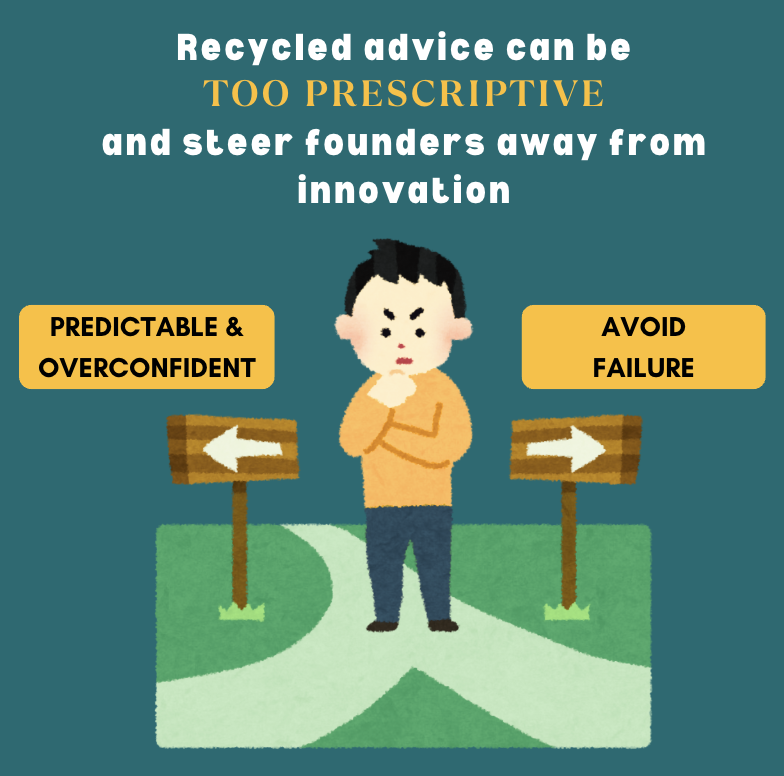
Problematically, new founders are confident about predicting positive market/customer response to their product and believe that building it ASAP is their biggest priority.
Although Reid Hoffman’s popular MVP advice to “launch an embarrassing first version of your product” reinforces this flawed logic, it is still music to the ears of a resource-constrained founder. The fallacy of survivor bias is that new founders rarely place equal value on analyzing founders who FAILED using the same approach. Founders eager to make progress find “recipes for action” enticing.
Avoiding failure is a founder bug, not a feature
The truth is that most startups will fail. Founders should press hard on this truth, as early as possible.
This pursuit chafes against the instincts of high-achieving founders who have learned to avoid and fear failure. They took the career risk of founding a startup because they believe that their solution is the “right answer” to a big problem or opportunity.
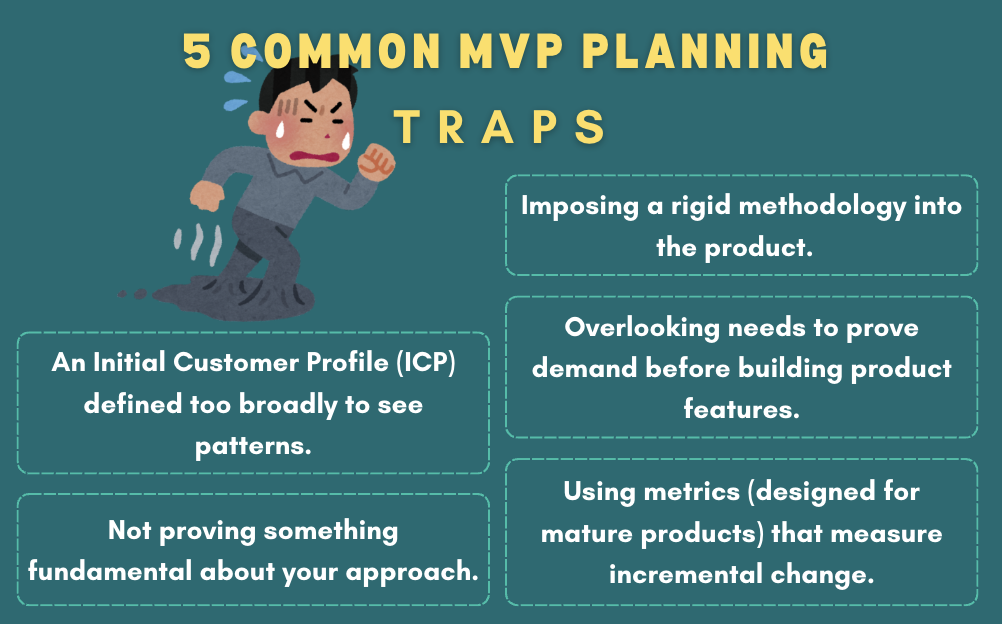
Like a smart student, they pick-up the tools of a capable corporate manager — financial models, risk analysis, and market studies. Traditional managerial approaches use predictive logic and failure avoidance. These are best suited to situations with past performance and relative stability; this is the opposite of their startup circumstances.
With the goal of “lowering their risk of failure,” founders over-index on managerial tools like a Business Model Canvas, KPIs, OKRs, detailed product roadmap, and P&L spreadsheets. Then, they splash in the “hacks” of successful entrepreneurs and garner attention for sharing product-building shortcuts for success, rather than truth seeking ones. Why? Because they’re harder to reduce to universal advice.
It is no surprise that founders begin their MVP and company building with sequential product roadmaps. They build MVPs as a “weak version one” of a big product. And, unsurprisingly, they measure progress with operational targets (e.g., get 10 new customers). These teams risk making a critical tradeoff: when building product features and hitting operational targets are tied to recognition and success, the “blinders” go on. Team members are less likely to make unexpected observations and share negative insights from their efforts.
“Traditional managerial logic puts execution at the center of a team’s purpose.
Founders forgo the adaptability and non-linear approaches used by successful entrepreneurs. ”
Most experienced entrepreneurs can’t tell you what they know
Like rats in a laboratory, a set of successful serial entrepreneurs in a research study revealed patterns in how they advance an opportunity amidst uncertainty.
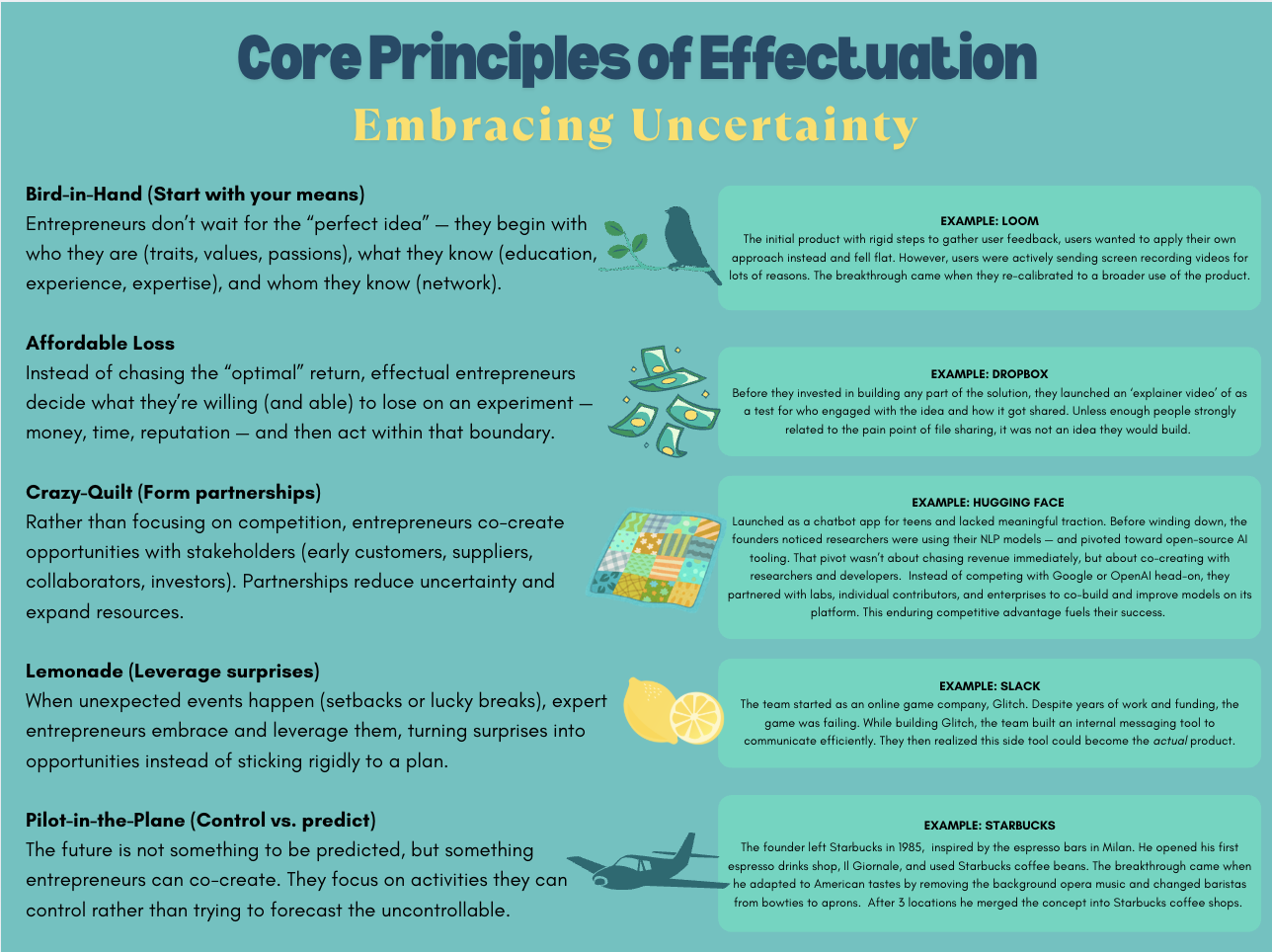
These ‘rule-breaking approaches’ are described within the Five Principles of Effectuation Theory, developed by serial entrepreneur, researcher and Professor Saras Sarasvarthy (see image below). Just as traditional managerial logic fails early startup founders, these principles are a mismatch within a stable enterprise where classic business strategy and prediction-based plans continue to work best.
First, they assess their existing capabilities and second, they strategically “flip” assumptions and by leveraging their existing capabilities.
These entrepreneurs demonstrated less concern with a specific output (e.g., get 10 customers), and instead, they pursued directional feedback that led to shaping a repeatable future effort (e.g., learn why 10 customers bought the product and 10 customers declined). Following through on this scenario, the experienced entrepreneur valued knowing why customers were saying “yes” and “no.” Directional feedback allows them to craft a repeatable sales program that may lead to getting 100 customers the following month.
MVP stories that navigated to massive success
While specific advice can mislead, stories and frameworks can inspire you to use new ways of thinking.
The stories of MVPs and successful pivots we highlight (see image below) illustrate how setbacks, surprises, and assumptions have been turned upside down and leveraged based on which principle they applied. We observe that these teams used a mindset of being primary observers of user and customer behavior rather than managers of engineering and implementation projects.
These mindsets led to uncovering insights that a) traditional metrics do not capture, and b) sometimes even turned conventional wisdom upside down.
Applying effectuation approaches
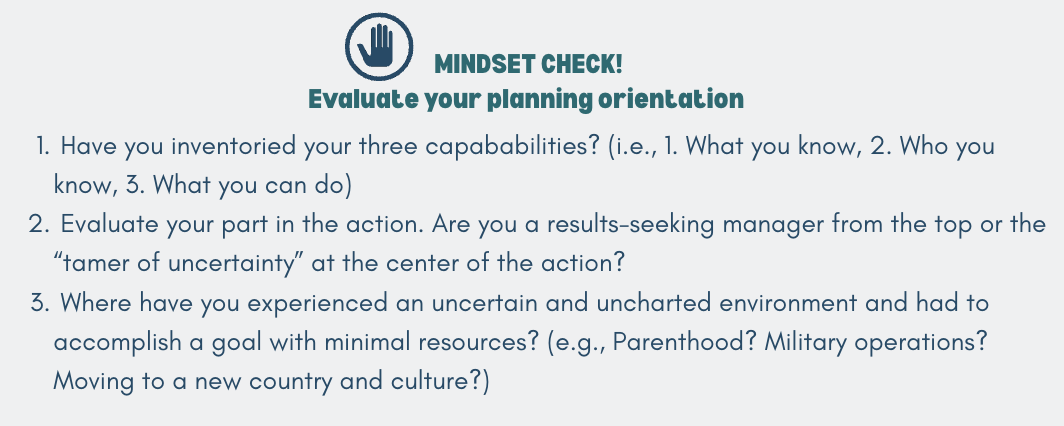
Founders can bring the mindset of effectuation logic to their own startups. To try it out, use the three steps outlined below.
Step 1: Inventory your capabilities
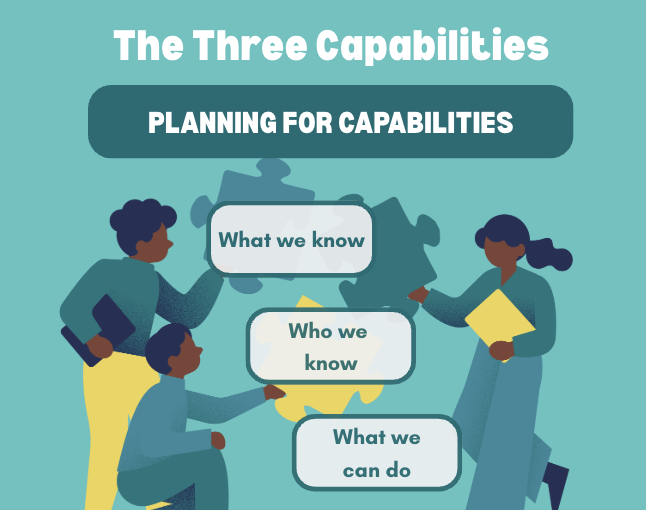
Ideally, a plan will compound one or more existing capabilities (e.g., how new users onboard to your product) Be expansive and creative in listing your unique unfair advantages. Often, they are right in front of you!
What you know about … the problem, the customer’s job, new technology, a macro trend, a niche industry.
Who you know that is … a potential design partner, existing customer, subject matter expert, past client, convener of your potential customers.
What you can do … offer professional services (before building the software,) cultivate an audience on social media, re-purpose existing product features, send a customized demo to a prospect.
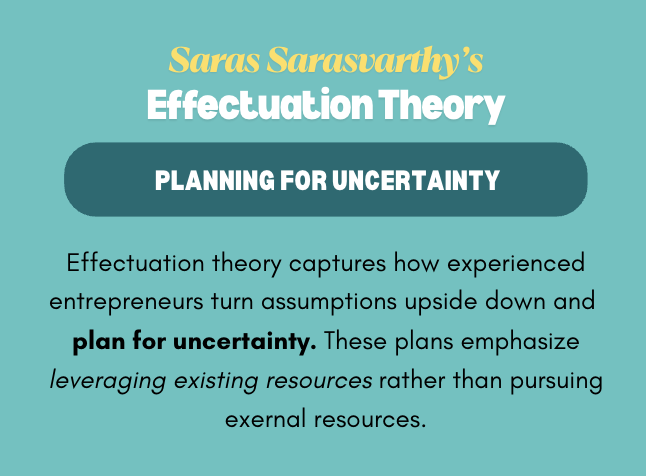
Step 2: Zoom out from thinking like a product builder to identify and rank your uncertainties.
Press hard on the biggest truths in your uncertain future — not through the lens of a linear product roadmap. Name and rank the critical assumptions you hold about the market/problem/customer and your solution.
What could you do to gain directional feedback … now?
In the Dropbox example, the founder sought to validate the intensity of need for their value proposition BEFORE building any technology or MVP. For Uber, their highest ranking uncertainty was the assumption that frequent cab riders would vastly prefer using a mobile app to request a private ride than calling a taxi dispatcher.
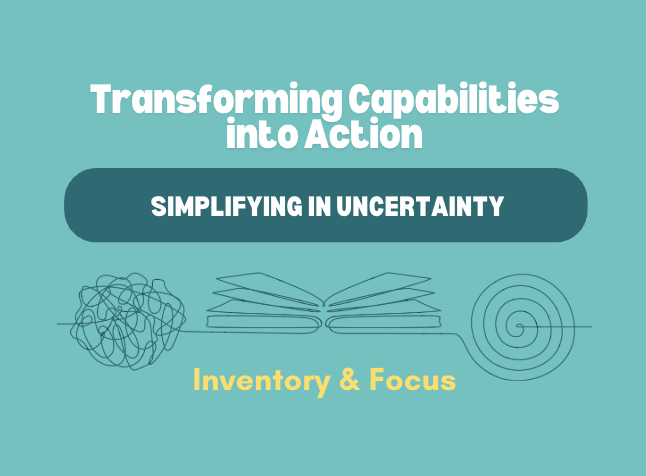
Step 3: Make a plan by using the five principles to brainstorm ideas.
An ideal plan leverages your existing capabilities AND delivers directional feedback related to a top ranking assumption.
Often, it means using simpler tools (e.g., an export and PDF) rather than building software or a V1 of your solution.
Let directional feedback pull you toward a solution and viable business model.
Concluding thoughts
All startups begin as non-viable businesses, propped up by founder sweat equity and outside investment. Traditional managerial logic and out-of-context advice frequently leads new founders astray.
Effectuation logic and the five principles describe how successful entrepreneurs navigate opportunity and uncertainty toward a successful outcome. The framework illuminates a mindset that encourages founders to dig deeper into their own context for answers, direction and traction.
Next,
What might you do differently?
Having reflected on your approach to startup strategy and planning, what will you do more of … less of … or change ? Does your team have the right mindset?. What could you try?
Tell us what you learned in this short survey so that our ‘zero-advice’ content gives new ways to think about your work.
Onward,
For related reading, check-out these online resources from our Reference Bookshelf
Connect with First Row
Upcoming Events