Exhibit: Vibe Coding & Customer Discovery
Start here.
First — S l o w D o w n Your Thinking
On any given day, your founder-mind is moving fast, and it literally prevents you from thinking strategically or creatively. Turning your focus toward an ambiguous art piece with complex themes is an opportunity to slow down your thinking and warm-up your analytical mind.
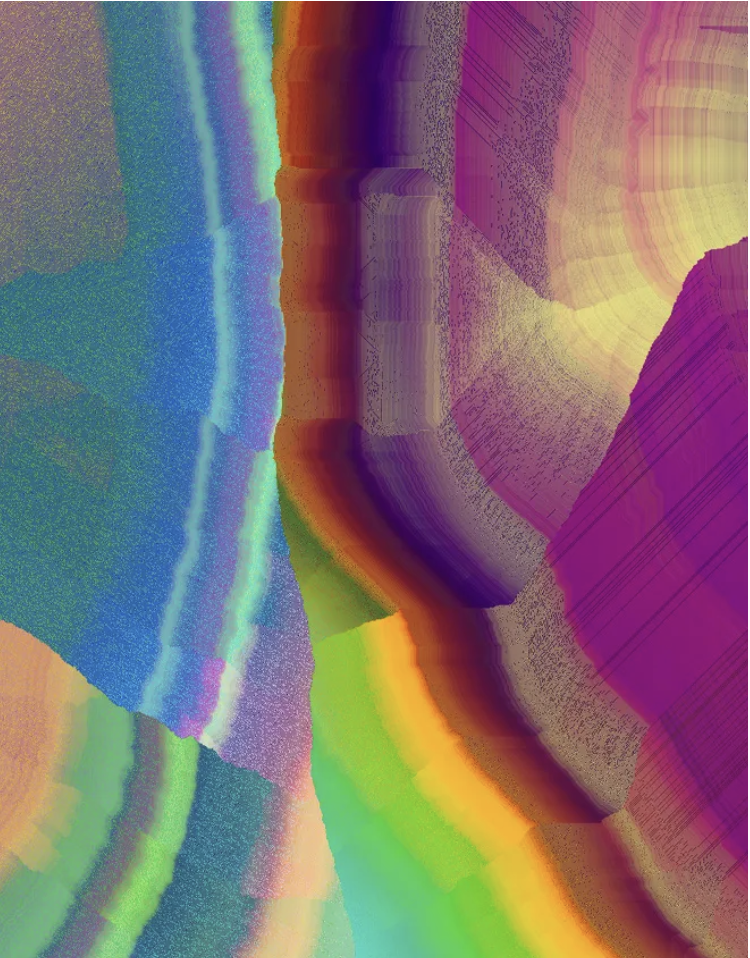
Describe the facts and elements. What colors do you see – try naming at least ten. What shapes and lines can you find? Where do you see blurring versus sharply defined edges? Is value (a color depicted from light to dark) part of the artist’s work?
Find the composition, systems and patterns. Consider the composition of the piece in terms of differences in spacing, scale and space/volume. Are lines and shapes moving your eye in a particular way? What does the movement in the piece remind you of? Are depth and scale ambiguous or defined? Can you find the ‘sections’ within the composition?
Brainstorm potential meanings. As you widen your perspective, what themes, moods and emotions come to mind? Stop for a moment to name them. Can you use the same information to build a totally different idea for meaning?
State your point of view. Did you make any interesting discoveries by slowing down to examine the details? What might you have missed if you looked away too soon? Can you give a title to the piece?
'Image credit: Adam Ferriss
From the 2013 article in Wired: “Ferriss experiments with all sorts of tools in making his algorithmic art, from Processing and other creative coding frameworks to real-time shaders and post-processing video effects.”
Get into ‘slow thinking’ mode - use the questions to study the art image before you dive in to read.
Now,
Think About: Vibe Coding & Customer Discovery
The prior “exhibit” in this series, Customer Discovery, emphasized process and interaction, not tech tools. So, what impact does vibe coding have on Customer Discovery if, “English is the new coding language?” TL:DR: Customer discovery is problem discovery. Not phase 1 of building a solution. Definitely not sales.
And, with so much hype about vibe coding goes a healthy dose of skepticism. This exhibit digs in to find value beyond the hype around vibe coding.
A quick search of Reddit posts and blogs quickly surface common risks and drawbacks of vibe coded solutions —
“The code isn’t scalable!”
“It’s riddled with security and compliance risk”
“It creates technical debt … superficial customer validation … creates a confirmation bias … a false sense of progress…”
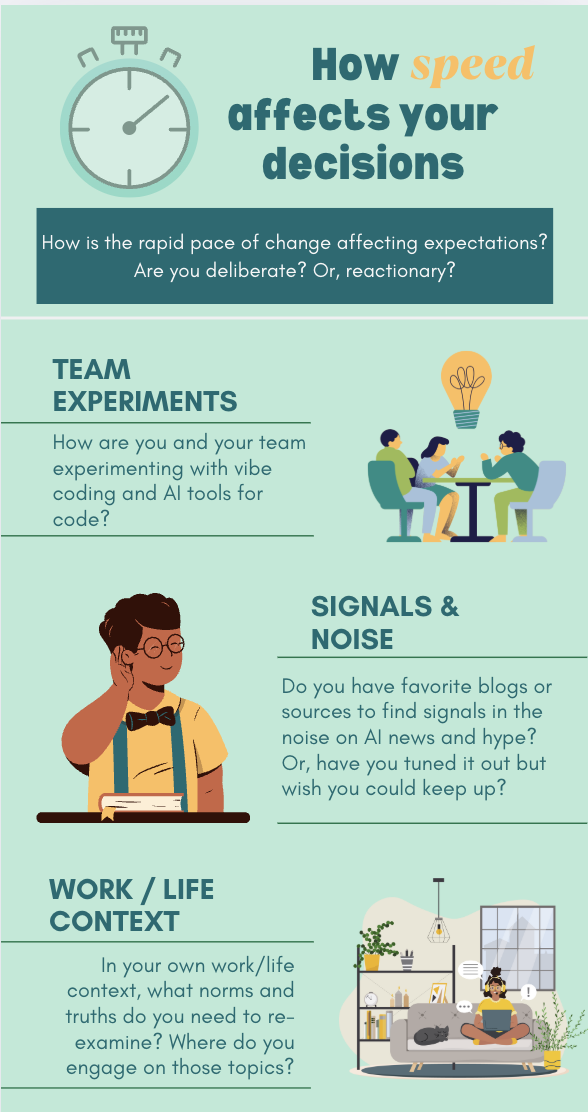
The common pitfalls in Customer Discovery— we highlighted are also context for this topic. The speed and instant results enabled by vibe coding can actually make these specific traps even easier to fall into!
Relying on a founder’s preconceived solution, rather than deeply investigating the real problem a customer faces before committing to a solution.
Using a prototype or demo as a sales tool, instead of as a means to genuinely learn from customers and understand their needs.
Rushing through the problem discovery phase — skimming over the underlying motivations and context that drive customer buying and usage behavior.
Falling for the illusion that the volume of code you create (features) is meaningful progress on your idea.
With the ease of vibe coding prototypes, how are you maintaining a thoughtful, open-ended, curiosity-driven customer discovery process?
Seattle founder James Lee working on an enterprise product shared how vibe coding improved how they refine design intent — not just increase the speed of writing code and delivering features. The “flow” of vibe coding removes distraction and lets him imagine the user’s needs and shape a design — similar to using notebook to sketch. After iterating, James can take output from that work and switch to a traditional tech stack.
He also defined two types of ‘vibe coders:’
Experienced developers who use AI to supercharge traditional stacks, maintain control, and ensure quality. No-code tools turn their technical skills into a creative collaboration, with rapid prototyping and fast iterations.
Non-coders who use AI-driven, no-code tools to build and deploy apps by describing their ideas in plain language, with minimal technical setup (e.g., Loveable, Bolt.)
Experts as gatekeepers
In the 2000s, when trained journalists and media producers scoffed at the democratizing influence of Tumblr bloggers and YouTuber creators, they feared irrelevance and the erosion of professional standards. Gatekeeping is a fixed mentality that blinds you to opportunities in your “own backyard.” Those incumbents minimized the disruption and lagged behind; others capitalized on the new storytelling formats, unfiltered voices and perspectives, and a change in qualifications for cultivating an audience.
In this familiar way, some traditional builders and technologists have taken to social media to downplay the wave of non-coders entering their domain. What bigger potential might they be missing?
Next, I turned my focus to defining the value of vibe coding beyond sheer code-writing productivity or launching hacked-together weekend projects. An office hours conversation with a UW student crystallized my perspective: Vibe coding can move design intent and collaboration to the forefront. The development process shifts to being artful, collaborative, and human-centered.
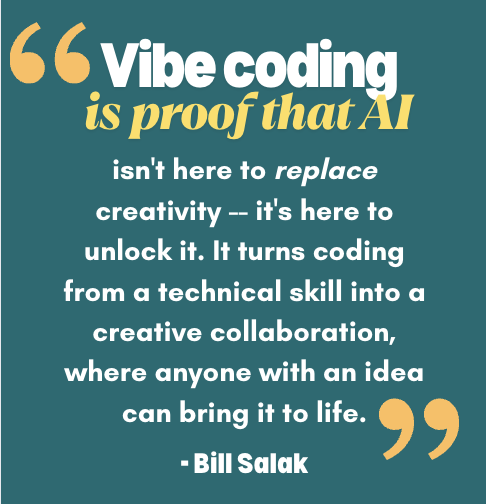
– Bill Salak is the CTO of AI education company Brainly (article)
When someone asks me to build something, I don’t wonder “how” to build it— I have infinite ways to figure that out. I ask them “For who? And why?”
— Ali Karim, summertime vibe coder and UW student
Even experienced technologists find that vibe coding activates creativity and joy — because it brings them immediately closer to the end user experience. This blog post describes this creative state and “why vibe coding feels so good.”
Flow State: Vibe coding often leads to the psychological state of "flow" - total immersion in the task. Time disappears, and you’re just vibing with the code.
Creative Freedom: There's no pressure to get it perfect. No deadlines or code reviews. Just the thrill of building.
Rapid Prototyping: It’s one of the fastest ways to get an idea off the ground. You’re not worrying about folder structure - you’re writing code that does something.
Learning-Focused: Vibe coding naturally leads to discovery. You try things, break things, and learn from the mess.
The processes driving creativity in art, engineering and science innovation are remarkably similar. Although each discipline expresses a distinct aesthetic, they share the need for clear intent and a pursuit of originality.
Clarity on an idea or experience is essential
Messiness and failures lead to breakthroughs
Ignoring best practices
Rapid iteration and feedback drive progress
In this “laboratory” or “studio” environment, startup entrepreneurs are rarely solo artists; they require the friction of collaboration across disciplines and perspectives to unlock a breakthrough customer insight. Lines between designer, product manager, developer and customer change when they collaborate visually and increase iterations.
How are you applying vibe coding tools to build more beautiful, emotionally engaging and user-centric products? Or, are you just shipping code faster?
Consider these questions to inspire a connection within your own preferences, skills, and experiences:
What ‘creative freedom’ do you and your team have? Where can you ‘ignore best practices’ and test new approaches?
What are your “go to” methods for improving your expression in narrative/storytelling? Making presentations for an audience? Teaching? Art? Music? Poetry?
What tools/surfaces to you prefer to reflect on complex ideas & insights as you consider what comes next?
How do you personally relate to the notion that creative art processes and engineering are alike? What examples come to mind from your own experiences?
When have you build something creative and collaborative where you took pride in the process and the results? Who do you admire who does this well?
The value of vibe coding is not that you can build faster — but build better and more user-centric solutions. Teams whose product aesthetic reflects the humans and systems involved, not merely the tech and business requirements, will be the big winners.
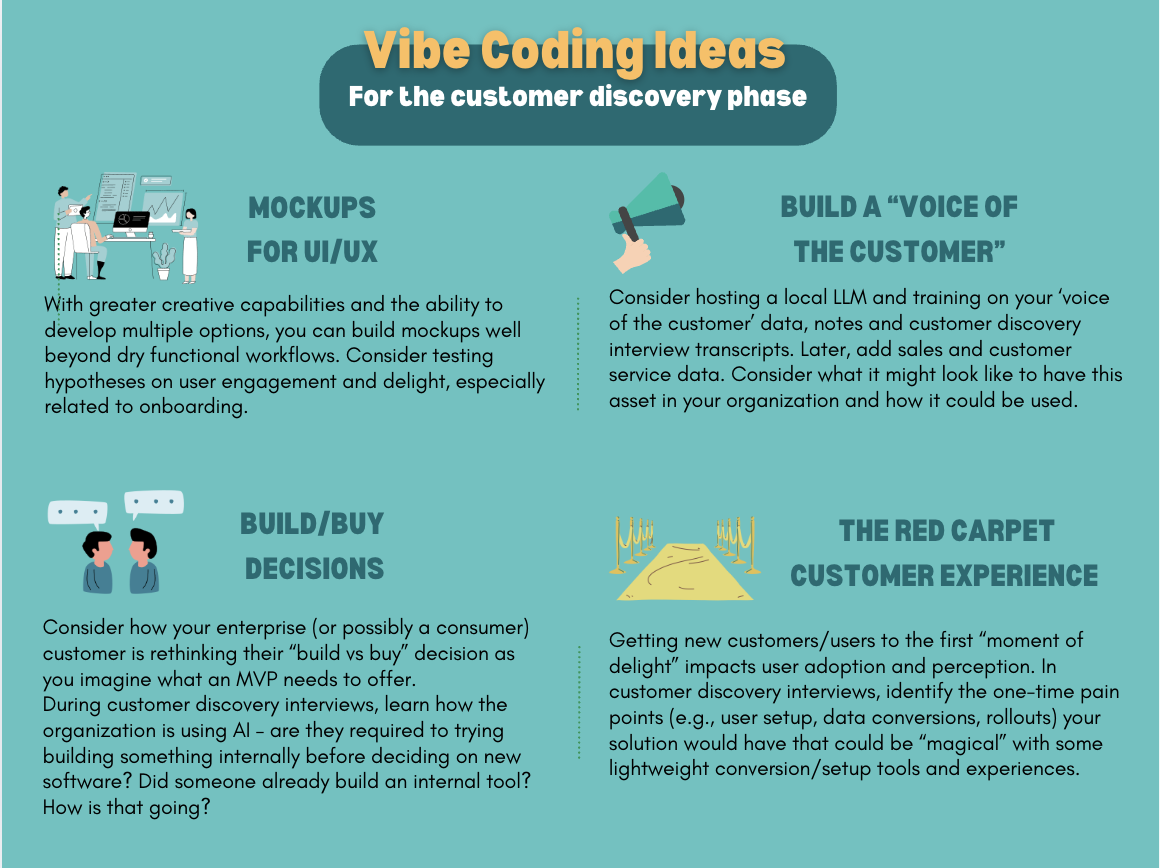
Next,
What might you do differently?
Having reflected on your views and approach to vibe coding and customer discovery, what will you do more of … less of … or change ? Does your team have the right mindset?. What could you try?
Tell us what you learned in this short survey so that our ‘zero-advice’ content delivers what you need.
Onward,
For related reading, check-out these online resources:
p5.js is a friendly tool for learning to code and make art. It is a free and open-source JavaScript library built by an inclusive, nurturing community. p5.js welcomes artists, designers, beginners, educators, and anyone else!
Ultimate Vibe Coding Guide post on Reddit is a good starting point for getting started on your first vibe coding project.
Top 10 Vibe Coding Tools Designers Love in 2025 blog post lists resources and gets specific on building and testing with a designer’s eye.
Look below for selections from our Reference Bookshelf related to critical thinking, art, and product design.
Connect with First Row
Upcoming Events