
Exhibit: Total uncertainty and your MVP
Start here.
First — S l o w D o w n Your Thinking
On any given day, your founder-mind is moving fast, and it literally prevents you from thinking strategically or creatively. Turning your focus toward an ambiguous art piece with complex themes is an opportunity to slow down your thinking and warm-up your analytical mind.
Use the art image and questions to get into your ‘slow thinking’ mode — then dive into the article.

Describe the facts and art elements. Identify the different types of lines you find. What shapes can you name? What characters, symbols and people can you see? What colors do you see? How would you characterize the colors as a palette - Are they primary colors, seasonal, bright or dark?
Find the composition, systems and patterns. Find the major the sections of the piece. How are they spaced and relating to each other? Where do you eyes move within the piece? Do they follow a consistent path or do you “jump around?” Do you see boundaries or motion? Where are elements and patterns repeated ? Do you see animals or characters ?
Brainstorm potential meanings. Is this just a “moment in time” or a full storyline? Do you see a “beginning, middle and end?” What kinds of intentions and attributes can you ascribe to the characters? For the two clay-colored people depicted, why are they the same? Why are their arms up? If this piece had a sound or music, what would it be like?
State your point of view. What do you believe is the purpose of this piece to the viewer? What are we supposed to know from the story or characters after viewing it?
Three Dreamings: Fire, Mulga Seed and Emu | 1993 |
Rosie Nangala Fleming, Australian Aboriginal, Warlpiri people | synthetic polymer paint on canvas
Now,
Think about this…
Even the best advice can mislead you, especially for MVPs
Founders seek advice, and get lots of it.
… Deliver just enough core value to early adopters to test hypotheses and validate demand!
… Optimize for fast iteration: launch, measure, and adjust in short cycles rather than aiming for initial perfection!
… And Reid Hoffman’s famous quote, “If you’re not embarrassed by the first version of your product, you’ve launched too late.”
Minimum viable product (MVP) advice from successful entrepreneurs is wildly abundant. The founders are visible and vocal. New founders admire their hard-won successes and actively planning to avoid the embarrassment and shame of failure. They (too quickly!) apply these axioms and expect a similar outcome.
Since that isn’t how it really goes, what is going wrong here? In this article, you’ll find an answer in three parts.
In parts one and two, we explore founders’ relationship with avoiding failure in two observable ways. First, it looks like founders behaving like a “real company” believing it will lead to one. And, they cut—paste the latest startup advice without adapting it to their situation. Awareness of these missteps is useful, but not actionable. So, we offer an approach in part 3.
Part three introduces Effectuation Theory as a method to leverage the patterns of successful entrepreneurs. It embraces uncertainty and open-ended outcomes. This orients the founder to make decisions that compound their capabilities and fill their gaps.
-
Good corporate managers set goals and allocate resources with readily available predictive information. Their methods and metrics are a misfit for the uncertainty early startups face.
-
Successful entrepreneurs frequently overstate the weight of their actions and degree of control over their outcome. Any prescriptive advice carries the weight of “survivor bias.”
-
Introducing, Effectuation Theory. Five principles and its decision framework fit the MVP stage by leveraging the patterns of serial entrepreneurs and how they navigate with uncertainty in ways that lead to fruitful outcomes.
TL:DR Managerial thinking will sink your ship
Uniformity, predictability and low failure rates exist for a commercial airline pilot flying a 747 from NY to LA in 2026. In 1804, Lewis & Clark’s expedition across the Louisiana Purchase to map a direct commerce route to the Pacific Ocean was totally uncertain. The destination was known, but there were no roads, no maps, and no Walmart stores along the way. They had $2,500 in funding plus canoes, hunting gear, telescopes and compasses. A startup is much more like one than the other.
Applying the “best practices” of an established company doesn’t work
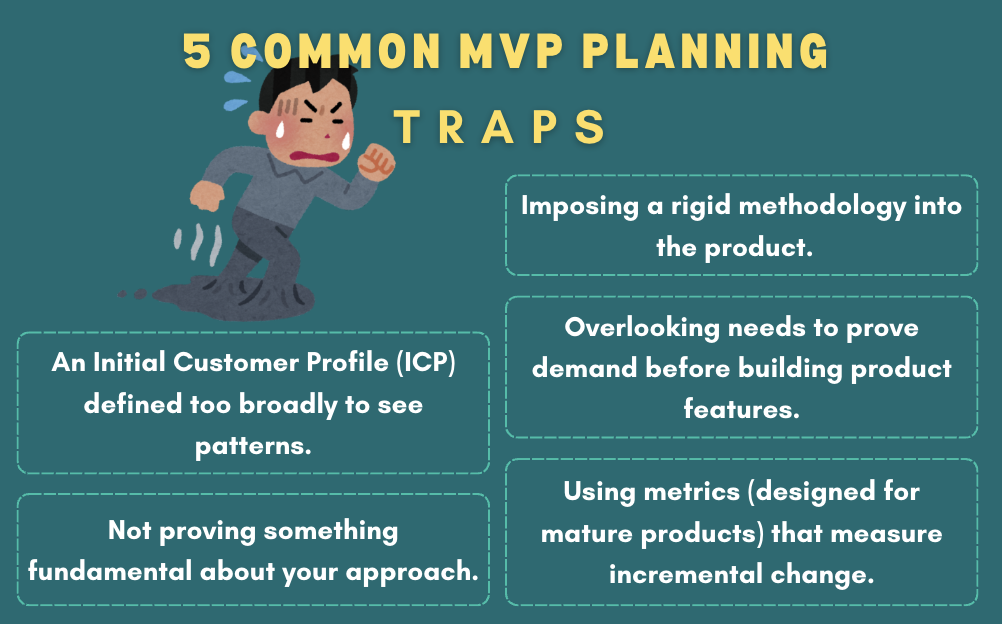
Many MVP planning mistakes originate from using well-tested managerial methods for periodic goal-setting and defined outcomes — the same practices frequently taught to MBA students. The difference between your startup and an existing company is that corporate managers seek incremental progress on the mechanisms around a proven business. They calibrate and predict outcomes using past performance data,; they exist in a world with budget funding requests and approved hiring plans. Conversely, startup reality faces total uncertainty and an unproven business model. Even large amounts of capital and resources can’t predict or manufacture innovation success. The “wilderness terrain and unforeseen obstacles” are frustratingly untamed by logical, predictive planning practiced at established companies..
In fact, attempting to predict a specific outcome creates a HIGHER risk of failure. Predictive planning only tells you the margin by which you reached the intended outcome; it does not guarantee new learnings or capacity building. It does not even validate that the intended outcome was the right pursuit to begin with! This planning trap can cause you to miss breakthrough insights, track the wrong metrics, and build unwanted features.
For example, you set an outcome/goal of signing 10 pilot customers within 3 months. In three months, you will definitely know how close you were to signing 10 customers. But—- you may not know that you could have signed 100 OR that you should have re-evaluated after six weeks because your first 5 customers never onboarded.
In the desire to avoid failure, founders may mirror established “managerial best practices” and feel productive because they are executing work toward a goal they set. This false sense of certainty looks like — setting KPIs, OKRs, building detailed product roadmaps, and creating multi-year projections with steady upward growth. A founder may be convinced that their managerial infrastructure and instrumentation will deliver the great outcomes they seek. In fact, they risk so much more when they stop asking questions and diligently execute “the plan.”
“Survivor bias” feeds a predictive mindset
Borrowed advice from successful entrepreneurs can create a optimistic believe in an inevitable success. On tech podcasts and in mentoring sessions, the expert entrepreneur may espouse that launching with an “ugly interface” will have saved time and resources while getting to market faster (famous Reid Hoffman advice.) The riddle here is that the founder rarely places equal value on the founders who FAILED by applying the exact same approach. Survivor bias has distorted the picture and oversimplified the context. Add to this, founders are attracted to advice that preserves their limited time and resources — any advice that sounds like a “smart hack” is alluring.
Always avoiding failure is a founder bug, not a feature
The truth is that most startups will fail. For the founders avoiding it at all costs, they burn valuable time and money. Their personal opportunity cost can be high. Pursuing the truthful answer to the viability of your idea/company/hypothesis does not come instinctively to high achieving founders who have deftly avoided feeling the shame of a clear failure. They were probably great students and good employees. Now, they are founding a startup because believe that their solution is the “right answer” to a big problem. As covered in our Customer Discovery posts (1, 2), bold founders seek to understand the landscape (i.e., job duties, priorities, unspoken beliefs) through the lens of the paying customer and end user. Too often, founders (especially technical ones) are backing into that understanding from their own pre-determined solution.
Are you getting sideways with your MVP?
Yoko and I spoke with a smart, energetic founder who had launched his consumer mental health app four weeks prior. He recruited seven beta users who expressed interest after his social media post. The founder showed us his dashboard of all the “right” metrics he was tracking for a mobile app — # of downloads and active usage (daily, weekly, monthly.) He asked us what patterns or other metrics he should be looking for and how to grow his user base. Also, he expressed concern that the users were using the app “the wrong way” by only tracking their heart rate variability (HRV) rates. He had expected them to adhere to his relaxation breathing activities.
First, we believe he misunderstood that those dashboards and metrics are informative only for established apps with a high number of users, established customer segments,, and years of past data on churn and paid conversion rates. These enterprises use such dashboards to identify pattern shifts and find opportunities for incremental change. Also, we believe this founder overlooked an opportunity to dig into the thing that was working — HRV tracking. His plan was to wait 30 days and see who renewed their subscription.
We recommended that he speak to his seven users directly, without delay. We encouraged him to get curious about why they liked the HRV tracking and seek to understand what they valued (and didn’t.) Waiting for “enough data” was pointless right now because it just ran down his runway. He needed to look for 'glimmers of hope’ and insights instead of steady and linear growth.
TL:DR Most experienced entrepreneurs can’t tell you what they know
But, like rats in a laboratory, a set of expert serial entrepreneurs participated in a research study, and the experiments revealed patterns in how they uniquely approach the uncertainty and wilderness territory of a new idea and company viability.
Use their patterns (not their advice) to make decisions that compound your capabilities
Patterns and lessons from this research study became the five principles of Effectuation Theory.
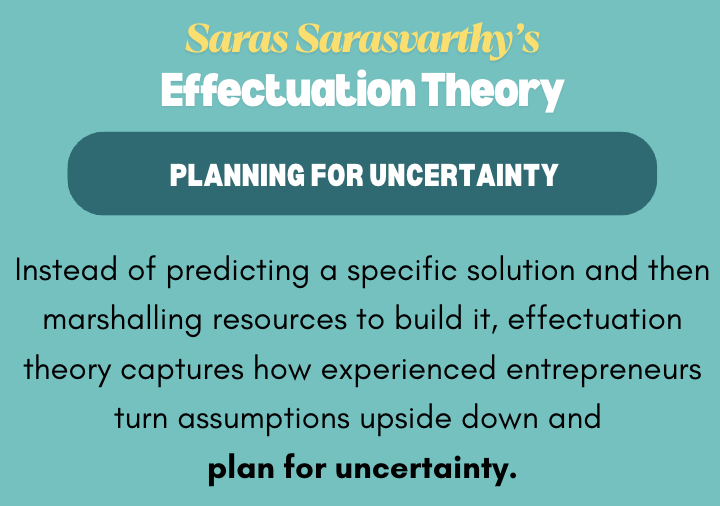
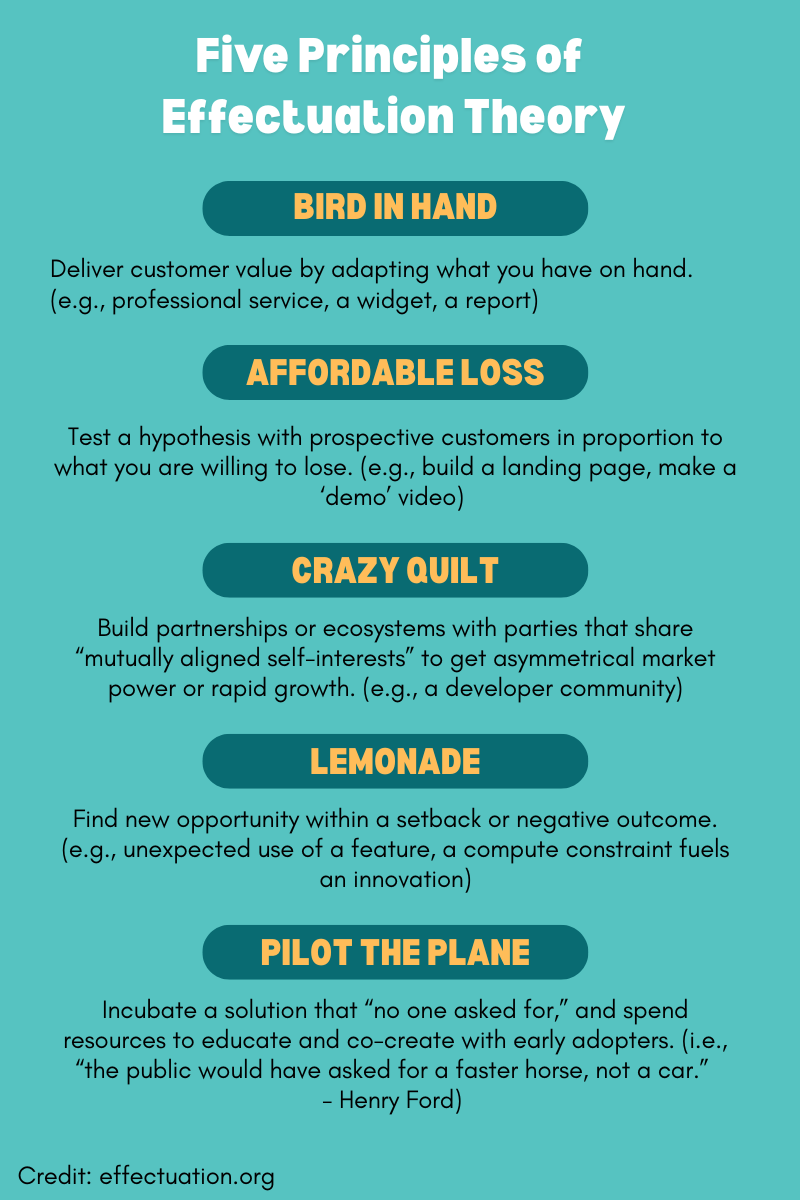
Developed by Saras Sarasvarthy, a professor at University of Virginia’s Darden school, “effectuation logic” describes how expert entrepreneurs think, act, and make decisions in the initial stages of new venture creation. The five principles are defined in the graphic below, but perhaps more importantly — they are illuminated through examples of five category-defining companies below it.
Expert founders learned to navigate WITH uncertainty by choosing what they control rather than attempting to predict specific outcomes. In doing so, they eventually find the “end of the wilderness” and started “building roads and using their maps” to make their business expand and grow to how we know them today.
The five principles are not classic business strategy, competitive moats, or prescriptive advice. They are approaches that rely on a founder applying their situational awareness to make decisions that compound toward increasingly larger successes.
Illustrating the Effectuation Theory with real world examples
We collected stories from well known startup successes: Loom (Bird in Hand), DropBox (Affordable Loss), Starbucks (Pilot the Plane), Shopify (Crazy Quilt) and Slack (Lemonade) to the illustrate the five Effectuation Theory principles.
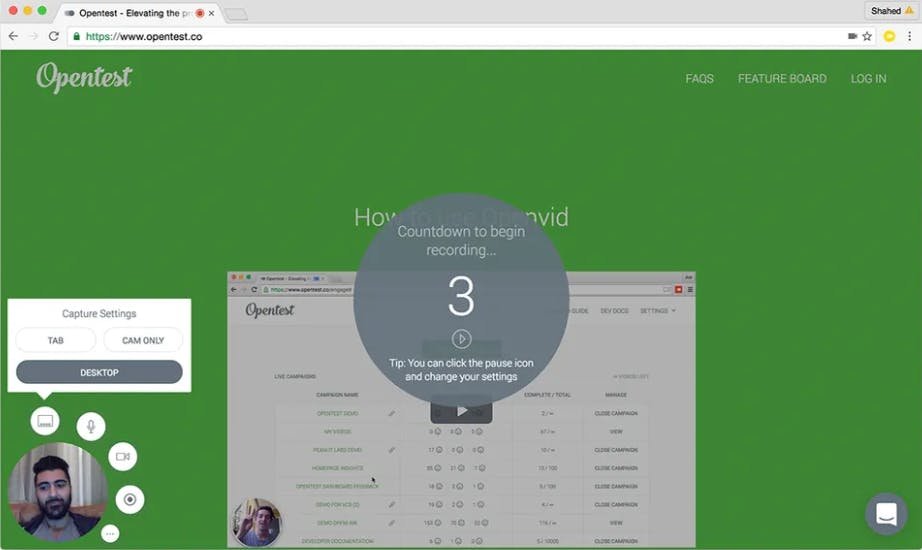
Loom (Bird in Hand)
Loom’s initial product offered a fully featured product for gathering user feedback, and it fell flat. However, users were actively sending screen recording videos for lots of other reasons. After cutting every other feature, they repositioned Loom as a general purpose tool. User adoption was immediate and exponential.
Loom’s initial product had one great feature — screen share recordings.
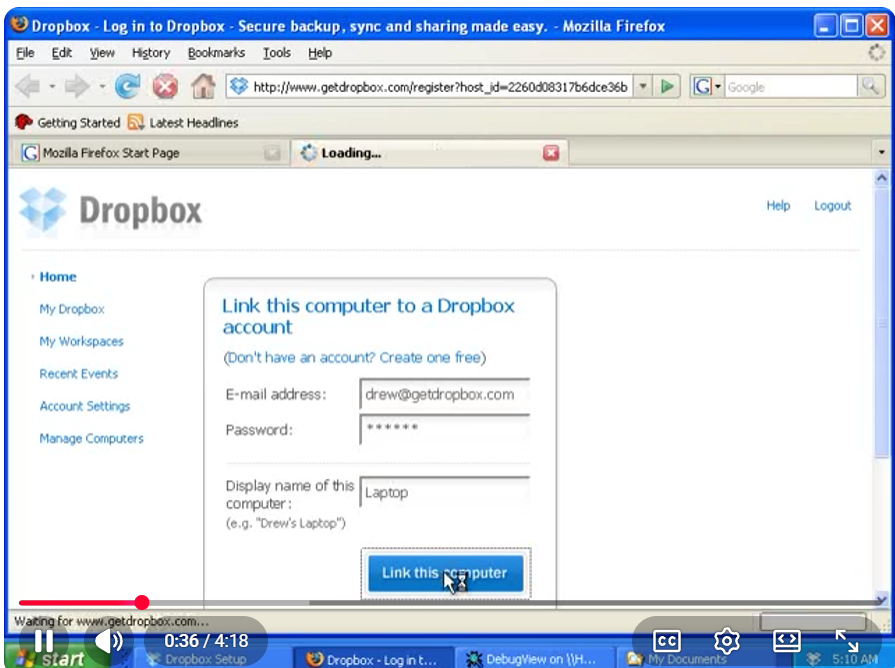
Dropbox (Affordable Loss)
Before deciding to build any part of their product, the founder launched an ‘explainer video’ of their full solution as a test for who engaged with the idea and how it got shared. The viral response showed that the pain point of file sharing was pervasive and big.
A screenshot from the YouTube video at https://www.youtube.com/watch?v=uGKnc6zVluw
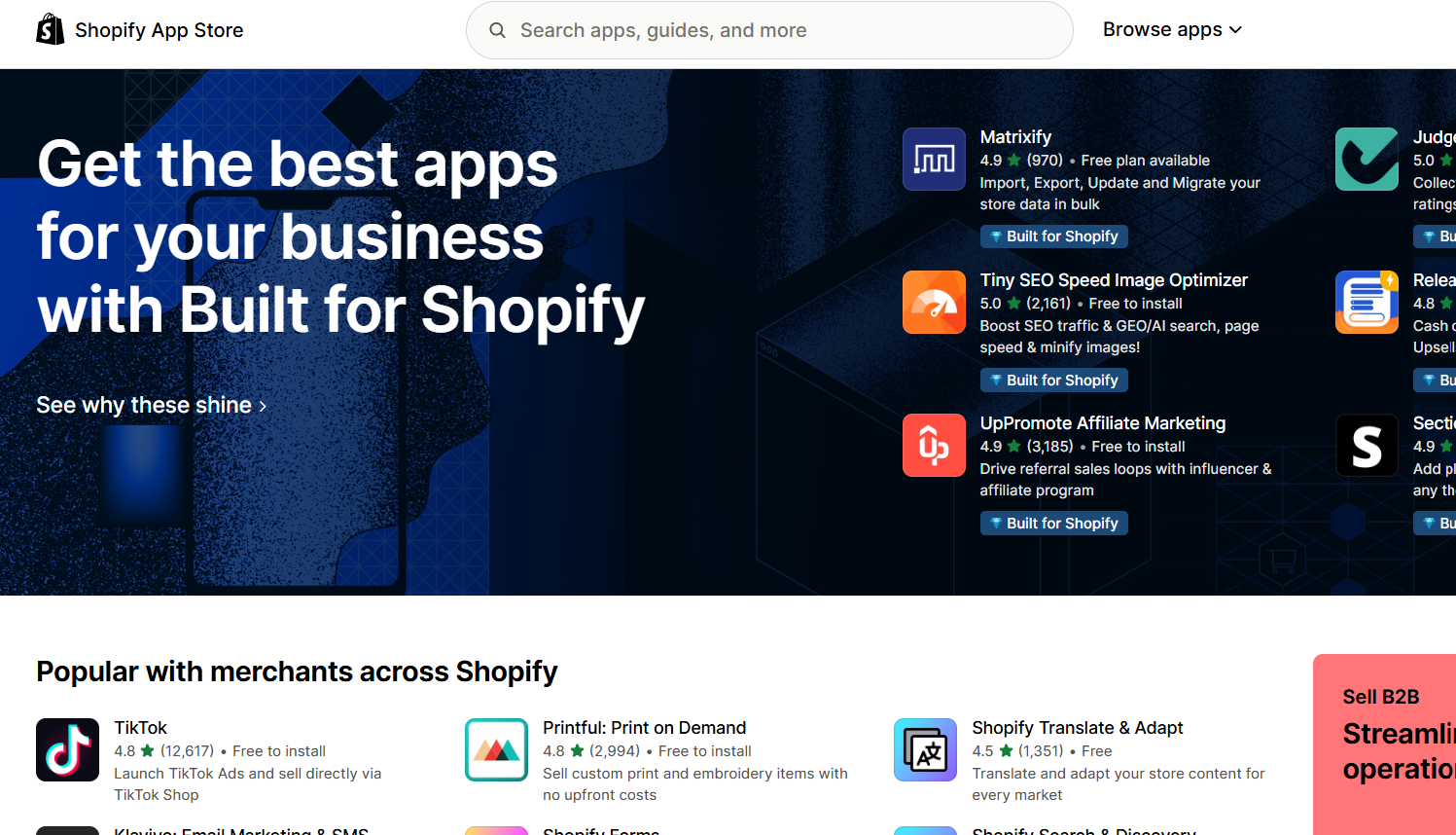
Shopify (Crazy Quilt)
Rather than attempting to build everything in-house when they were new and resource constrained, Shopify founders invited independent software developers to co-create features and plug-ins they could sell in a Shopify App Store. In addition to rapid feature expansion, Shopify can identify popular features for their core product.
Shopify’s App Store features solutions built by developers.
Shopify’s App Store features solutions built by developers.
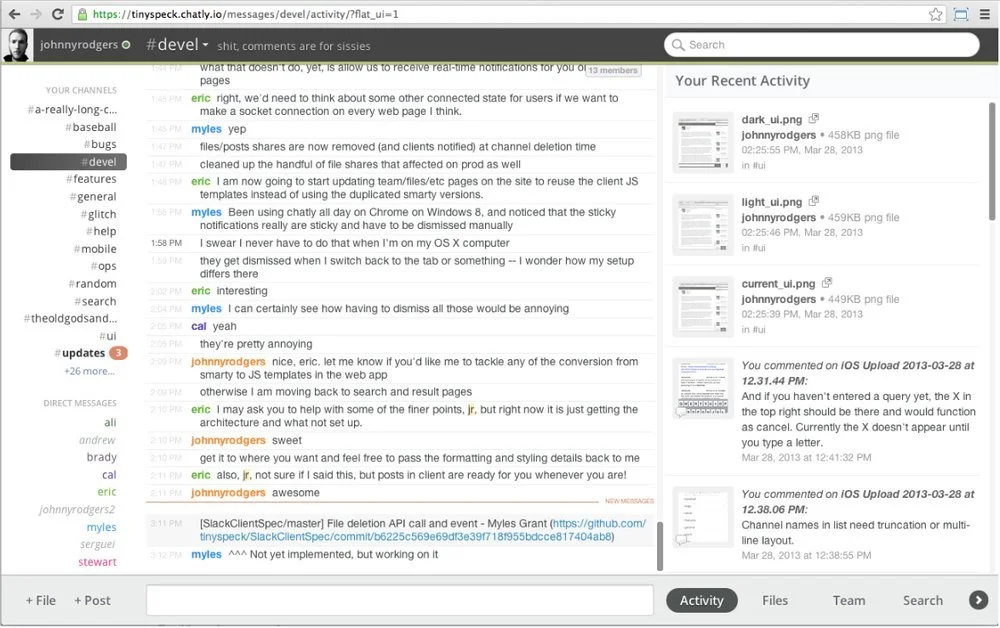
Slack (Lemonade)
The team that originated Slack began as an online game company, Glitch. Despite years of work and funding, the game was failing. While building Glitch, the team created an internal messaging tool to communicate efficiently. They pivoted for this internal tool to become the company’s product — Slack.
The Glitch internal tool. Credit: Startup Guy blog. March 15, 2025.

Starbucks (Pilot the Plane)
Inspired by the espresso bars he experienced on a vacation to Milan, Italy, a Starbucks leader departed in 1985 (back when the small chain sold coffee beans, tea and spices.) He opened his first concept shop, Il Giornale but used Starbucks coffee to make his drinks. Leading with his “one cup at a time” mantra, the store experience focused on consumer education, handmade fixtures and lots of free samples. Responding to customer preferences, they removed the background Italian opera music and changed the barista uniforms from bowties to green aprons. After establishing three profitable locations, he merged the concept back into the still-regional Starbucks stores, where they proceeded to bring the coffeehouse concept to the masses.
An Il Giornale storefront. Credit: Starbucks.com.
Applying entrepreneurial logic
In each of the five examples and principles, we observe traction and breakthroughs being discovered in iterative cycles. Starbucks built their business with the mantra, “one cup at a time.” It captures the compounding cycle of action, feedback and response — the entrepreneurial logic that grapples with total uncertainty.
Each founder starts the next “cycle” by choosing something they have under their control — and taking an inventory of the capabilities they have.
Step 1 - What is in your control? What capabilities do you have?
Use three categories to inventory things you can control/impact and capabilities you have.
What you know
Who you know (and who knows you!)
What you can do and deliver
Step 2 - What action will increase what you control?
Make a plan of action which leverages one of the three to build capacity one (or more) of the others. It should activate feedback and learning, not target a predicted outcome. The scope and size is only as big as the team can AFFORD to LOSE. (This should increase over time.)
Some sample scenarios —
Leverage # 1 to increase # 2 — I know how to repair bicycles—> So I create entertaining viral YouTube videos to increase my visibility.
Leverage # 2 to increase # 3 — I have an online teacher community —> So I offer opportunities for certified ongoing education credits where teachers develop data I need for my AI solution.
Leverage # 3 to increase # 1 — I have remote sensor data that for a future a software dashboard and alert solution for engineers who monitor power lines—> So I send my beta customers a daily PDF file via email in exchange for feedback and learnings on their format preferences, frequency of need and the related workflow uses. If it becomes high value to them, I’ll build it into dashboard and alert solution.
Step 3 — What next opportunity/action did the learnings unlock?
Embracing surprises (that includes setbacks and disappointments) is where the next opportunity lies. Be circumspect and embrace what you know have. What capability did you increase ? What can you unlock as the next opportunity?
A founder’s willingness to be wrong, foolish, or misunderstood greatly impacts what they observe and the opportunities they uncover. The iterative loops of building capacity leads to meaningful progress on their broader ideas and strategies.
Next,
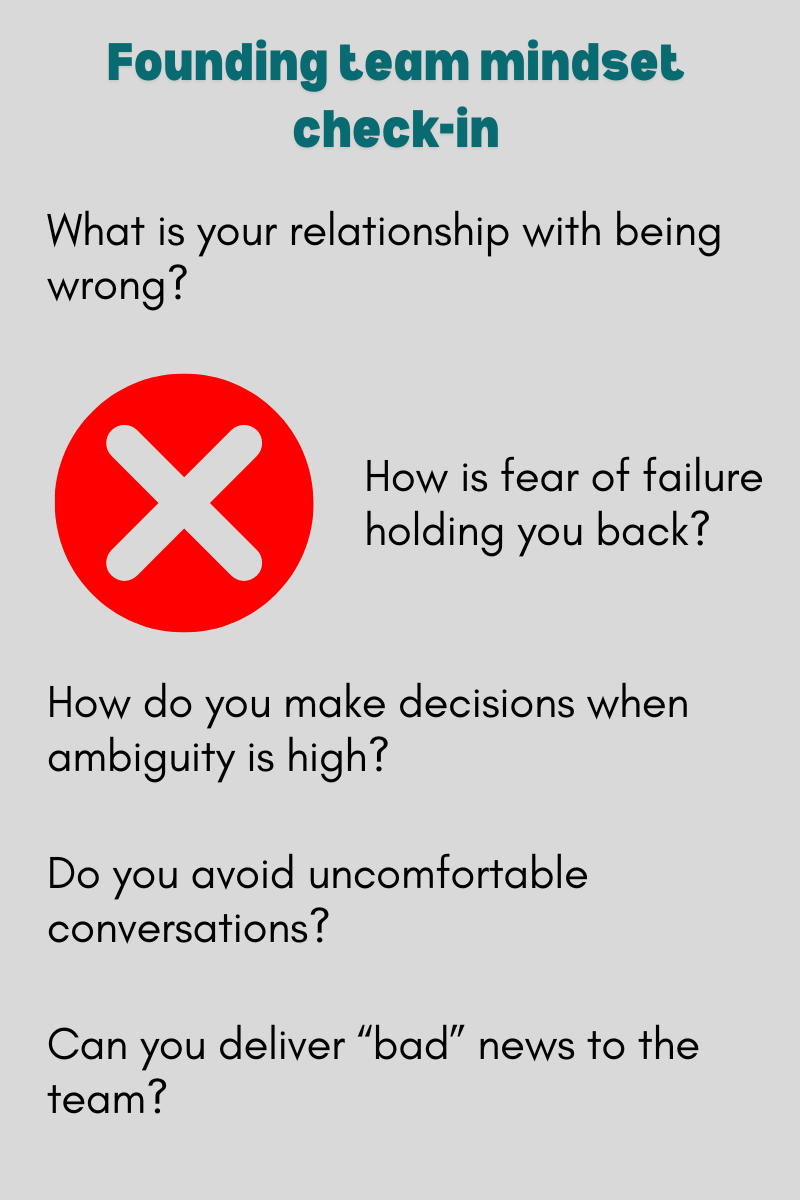
What might you do differently?
Having reflected on your views and approach to vibe coding and customer discovery, what will you do more of … less of … or change ? Does your team have the right mindset?. What could you try?
Tell us what you learned in this short survey so that our ‘zero-advice’ content delivers what you need.
Onward,
For related reading, check-out these online resources from our Reference Bookshelf
Connect with First Row
Upcoming Events